A six-story mixed-use project on 200th Street hit a layer of silty clay at the bearing elevation that the standard SPT couldn't fully characterize. The structural engineer needed more than cohesion and friction angle estimates—they needed the complete stress-strain curve to model settlement under sustained dead load. That's where a triaxial test becomes non-negotiable. In Langley, where the subsurface shifts from glacial till to soft alluvial deposits across just a few blocks, we run consolidated-undrained and consolidated-drained triaxial tests to isolate the effective stress parameters that govern long-term stability. The Township's building department reviews these results against NBCC 2020 and CSA A23.3 requirements, and the difference between a well-designed foundation and an under-designed one often sits in the triaxial data. For deep excavations in clay-rich zones near the Nicomekl River, we pair triaxial testing with in-situ permeability measurements to model pore pressure dissipation rates.
Effective stress parameters from a triaxial test give you the soil's real story—total stress numbers can be misleading in Langley's silty clays.
Method and coverage
Regional considerations
The glaciomarine clays found across Langley's low-lying areas pose a specific risk: sample disturbance during drilling can reduce undrained shear strength measured in the lab by 15 to 30 percent compared to in-situ vane tests. We mitigate this with thin-walled Shelby tube sampling and rapid specimen preparation under controlled humidity. Another concern is the misinterpretation of total stress parameters for a material that will drain over the structure's lifespan. Designing a retaining wall or mat foundation based on undrained triaxial results—without checking the drained case—has led to excessive long-term settlement in several Lower Mainland projects. The peat pockets mapped near the Fraser River floodplain introduce additional compressibility that a single triaxial test cannot capture alone, which is why we often combine our lab program with CPT testing to build a continuous profile of tip resistance and pore pressure. In seismic design, the cyclic triaxial test per ASTM D5311 provides the liquefaction resistance of sandy interbeds that the standard SPT-based methods can miss in transitional soils.
Standards that apply
ASTM D4767-11 (Consolidated Undrained Triaxial), ASTM D7181-20 (Consolidated Drained Triaxial), CSA + ASTM D2850 (Unconsolidated Undrained Triaxial), NBCC 2020 Division B Part 4 (Structural Design), CSA A23.3-19 (Design of Concrete Structures)
Complementary services
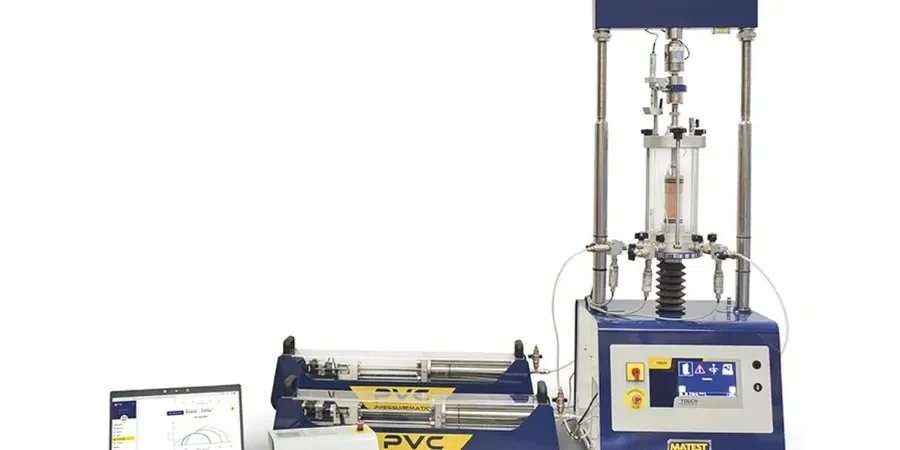
Consolidated Undrained (CU) Triaxial with Pore Pressure
The standard for slope stability and foundation analysis in Langley's saturated clays. Three specimens consolidated to different effective stresses and sheared undrained, with pore pressure measurement to determine effective stress strength parameters c' and φ'.
Consolidated Drained (CD) Triaxial
Applied to granular soils and stiff tills where long-term drained conditions control design. Shearing at rates as low as 0.01 mm/min ensures full pore pressure dissipation throughout the test.
Cyclic Triaxial for Liquefaction Assessment
ASTM D5311-based cyclic loading on saturated sandy specimens from depths up to 15 meters. We provide cyclic stress ratio (CSR) curves and pore pressure generation plots for NBCC seismic site classification.
Typical parameters
Top questions
How long does a full triaxial test program take for a Langley project?
A standard three-specimen CU triaxial test with pore pressure measurement typically requires 7 to 10 working days from sample receipt to final report. Consolidated-drained tests on low-permeability silts can extend to 14 days due to the slower strain rates required. We provide preliminary friction angle estimates within 5 business days when the project schedule demands it.
What does a triaxial test cost in Langley?
A complete three-specimen CU triaxial test package in Langley ranges from CA$2,300 to CA$3,280, depending on sampling depth, specimen size, and whether drained or cyclic add-ons are required. This includes saturation, consolidation, shearing, and a full engineering report with stress-strain curves and Mohr-Coulomb parameters.
Which triaxial test type is appropriate for Langley's glacial till?
For the dense Vashon glacial till common across Langley, a consolidated-drained (CD) triaxial test per ASTM D7181 provides the most reliable drained strength parameters. If the till contains significant fines and the project involves rapid loading—such as an excavation near existing foundations—a CU test with pore pressure measurement gives both total and effective stress parameters needed for short-term and long-term stability checks.