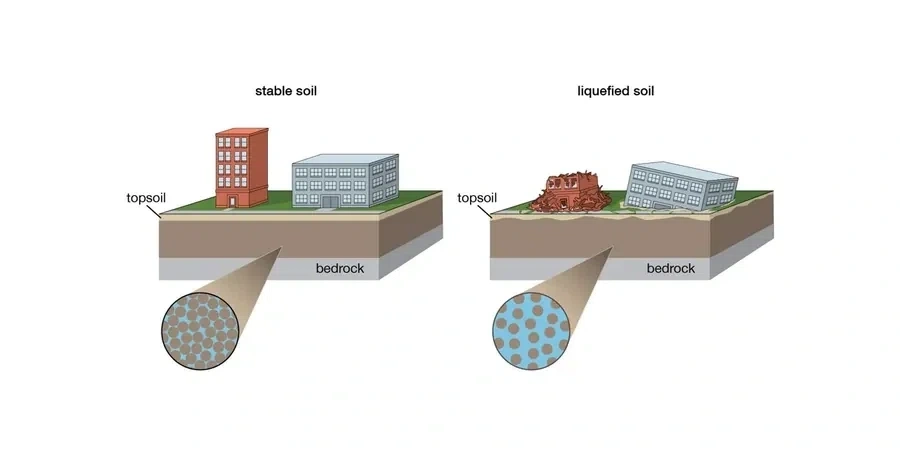
Langley sits on the edge of the Fraser River floodplain, where loose alluvial silts and fine sands extend tens of meters deep over glacial till and outwash. The shallow groundwater table, often within 2 to 3 meters of the surface in the Township’s lower terraces, creates exactly the saturated, unconsolidated conditions that drive liquefaction risk during a design-level earthquake. Under the 2020 National Building Code of Canada, much of the municipality falls into Site Class D or E, meaning a site-specific soil liquefaction analysis is not just a regulatory checkbox—it determines whether your foundation design needs Improvement, deep piles, or a reassessment of spectral acceleration. We run SPT-based triggering procedures using the NCEER/Youd-Idriss framework, paired with CPT testing where continuous profiling is needed to catch thin, critical layers that standard penetration testing alone can miss. For projects near the Nicomekl River or across the Salmon River uplands, the analysis often uncovers a sharp contrast between Pleistocene overbank deposits and Holocene channel fills, and that distinction changes everything about predicted settlements and lateral displacement.
A stiff surface crust over loose saturated sand doesn’t eliminate liquefaction risk—it conceals the hazard until excess pore pressure finds a breakout path.
Method and coverage
Regional considerations
The contrast between Langley City and the agricultural lowlands of the Township illustrates the problem well. In the City, older compacted fills and deeper Pleistocene deposits often yield cyclic resistance ratios above 0.3, and liquefaction triggering drops below the factor-of-safety threshold only in isolated pockets. Move south into the Township’s floodplain, where Holocene sands dominate and the water table sits higher, and we routinely see CRR values below 0.12 in the upper 6 meters—fully liquefiable under a 475-year return period event. The risk isn’t uniform across a single parcel, either. A site straddling an old meander scar can show 50 mm of differential settlement over 20 meters horizontally, enough to shear utility connections and tilt shallow footings. That’s why our soil liquefaction analysis reports always include a map of predicted vertical displacement and a lateral spread hazard zone delineation, so the structural engineer sees exactly where the grade beam needs reinforcement or where a Improvement cutoff line should go.
Standards that apply
NBCC 2020 – Seismic hazard and Site Class determination, ASTM D1586-18 – Standard Penetration Test (SPT) and sampling, ASTM D5778-20 – Electronic friction cone and piezocone testing (CPT), ASTM D4428/D4428M-14 – Crosshole seismic testing, NCEER/NSF (Youd & Idriss, 2001) – Liquefaction resistance of soils
Complementary services
SPT- and CPT-Based Triggering Analysis
We run both simplified and site-specific response analyses using field data collected under ASTM D1586 and D5778. The analysis applies the Boulanger-Idriss (2014) procedure with fines content correction, Kσ and MSF scaling, and reports factor of safety against liquefaction for each sublayer.
Post-Liquefaction Settlement and Lateral Spread
Using Ishihara-Yoshimine volumetric strain correlations and Bartlett-Youd lateral displacement models, we produce a settlement map and lateral spread hazard zone for the site. This directly feeds foundation design, utility corridor planning, and grading decisions.
Improvement Feasibility and Verification
Where liquefaction risk exceeds NBCC tolerances, we evaluate vibrocompaction, stone columns, or deep soil mixing. Post-treatment verification relies on before-and-after CPT or SPT data, with the same triggering analysis rerun to confirm performance.
Typical parameters
Top questions
When does the NBCC require a soil liquefaction analysis in Langley?
The 2020 NBCC requires a liquefaction assessment for sites classified as Site Class D, E, or F when the design earthquake has a PGA above 0.12g and the subsurface includes saturated, loose granular soils within 15 m of grade. Much of Langley’s floodplain meets these criteria, so the analysis becomes mandatory for most Part 3 buildings and essential infrastructure. We determine triggering potential, settlement, and lateral spread in accordance with the NCEER methodology referenced by the NBCC structural commentaries.
What’s the typical cost range for a liquefaction study on a single-family lot in Langley?
For a standard residential lot with two to three boreholes or CPT soundings and a full triggering and settlement report, the cost typically falls between CA$3,790 and CA$5,520. The final figure depends on access conditions, depth to refusal, and whether supplementary geophysical testing like MASW is required to constrain the Vs profile. Commercial and multi-family sites with lateral spread mapping run higher due to the additional analysis effort.
Can you run the analysis if only SPT data is available, or do you need CPT too?
SPT-based analysis is fully accepted under the NCEER procedure and works well when we have split-spoon samples with reliable fines content data. CPT adds value by capturing a continuous penetration resistance profile—essential where thin silt seams or interbedded layers control the liquefaction response. We often combine both: SPT for sampling and index testing, CPT for high-resolution resistance data. If only SPT logs exist from a previous investigation, we can absolutely perform the analysis; we’ll note any depth intervals where resolution limits the interpretation.