A crawler-mounted drill rig moves across a sloping lot in Walnut Grove, its auger biting into dense glacial till. That core sample, extracted at depth, becomes the starting point for every retaining wall design we produce in Langley. The Township’s terrain, shaped by the Fraser River’s historical meandering and Pleistocene glaciation, demands more than a standard gravity wall. It requires a design response calibrated to local stratigraphy: compact till over soft clay lenses, or sandy outwash with perched groundwater. Our technical team integrates site investigation data directly into the wall geometry, reinforcement schedule, and drainage specification, ensuring the final structure handles both static earth pressure and the seasonal saturation cycles typical of the Fraser Valley. For projects where the retained height exceeds 1.2 m, a slope stability assessment often accompanies the wall design to evaluate global failure mechanisms beyond the wall face itself.
In Langley, the difference between a durable retaining wall and a failing one often starts with how the drainage system interfaces with the native glacial till.
Method and coverage
Regional considerations
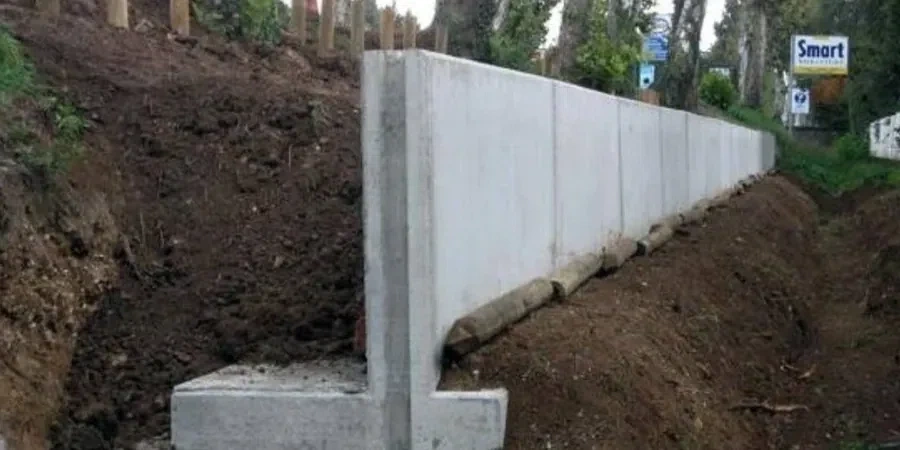
Langley’s growth from an agricultural township to a commuter hub has pushed residential development onto marginal land: ravines, creek setbacks, and former peat bogs. Many older subdivisions predate modern geotechnical codes, and retaining walls built without engineering input now show signs of rotation, cracking, or weep-hole clogging. The risk is not hypothetical. A wall that tilts into a neighbour’s property creates liability that insurance rarely covers. Our retaining wall design explicitly addresses the failure modes observed in the region: sliding along a slick clay seam, overturning due to inadequate heel width, and global instability triggered by heavy rainfall. We specify a minimum factor of safety of 1.5 against sliding and 2.0 against overturning, and we require compaction testing of backfill lifts to ensure the reinforced zone performs as modeled. When the wall supports a driveway or building pad, the surcharge load is calculated precisely, not estimated with a generic 12 kPa assumption.
Standards that apply
NBCC 2020 (National Building Code of Canada), CSA A23.3:19 (Design of Concrete Structures), AASHTO LRFD Bridge Design Specifications (retaining structures), ASTM D2488 (Soil Description for Engineering Purposes)
Complementary services
Geotechnical Retaining Wall Design Package
Stamped engineering drawings including wall cross-sections, reinforcement schedules, drainage details, and construction specifications. Based on site-specific soil investigation and NBCC seismic requirements.
Construction-Phase Geotechnical Observation
Field review during excavation, backfill placement, and compaction. We verify that the subgrade matches design assumptions and that drainage components are installed per the stamped drawings.
Typical parameters
Top questions
What does retaining wall design cost in Langley?
Design fees typically range from CA$1,460 to CA$5,260 depending on wall height, complexity, and the need for supplementary site investigation. A 1.5 m cantilever wall on a flat lot falls toward the lower end; a 4.5 m MSE wall with surcharge loading and a global stability analysis approaches the upper end.
Do I need a building permit for a retaining wall in the Township of Langley?
Generally, a permit is required for walls over 1.2 m in height, or any wall supporting a surcharge load such as a driveway or building. The design must be sealed by a licensed professional engineer registered in British Columbia.
How do you account for the high water table in parts of Langley?
We incorporate a continuous drainage system behind the wall, typically a perforated pipe wrapped in filter fabric within a free-draining gravel chimney. The design also includes weep holes at specified intervals and, where necessary, a drainage blanket extending into the backfill zone to lower the phreatic surface.