Langley's transformation from a fur-trade hub along the Fraser River into a thriving suburban center has placed heavy demands on its road infrastructure. The 200 Street corridor and expanding industrial parks near Gloucester Industrial Estates now require pavement sections that endure constant truck traffic without rutting. Rigid pavement design addresses this by distributing loads through concrete slabs rather than relying entirely on granular base layers—a crucial advantage in a region where the water table sits high during winter months. Our team has worked on arterial roads through the Township where the CBR road assessment values from the silty-clay subgrade dictated a thicker slab section, and we often combine this with in-situ permeability testing to design the drainage layer correctly. The goal is a pavement that resists pumping, faulting, and freeze-thaw degradation across Langley's full seasonal range, from January lows averaging 0°C to July highs near 23°C.
In Langley’s saturated silts, getting the k-value wrong by 15% can reduce a rigid pavement’s design life by half—subgrade reaction modulus is not a number to estimate from a table.
Method and coverage
Regional considerations
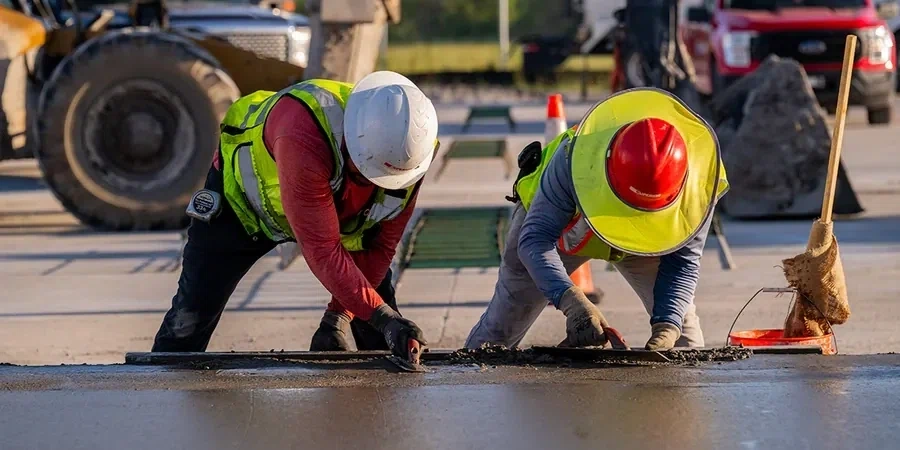
We often see rigid pavements in Langley’s older industrial parks that fail not because of poor concrete, but because the subgrade preparation ignored the perched water tables common in the Langley Uplands. Erosion of the subbase through unsealed joints leads to void formation under the slab corners, and once pumping begins, faulting at transverse joints follows within two or three winter seasons. Another specific risk is differential heave in the transition zones between cut and fill sections along roads like 88th Avenue east of 216 Street, where the glacial till meets compressible organic silts. Without deep excavation support during utility trenching and proper compaction verification under the slab, these transitions become maintenance liabilities. A rigid pavement designed solely by AASHTO empirical equations without a site-specific geotechnical investigation will almost certainly underperform in Langley's variable subgrade conditions.
Standards that apply
AASHTO 1993 Guide for Design of Rigid Pavements, CSA A23.1-19 Concrete Materials and Methods of Concrete Construction, ASTM D1196-21 Plate Bearing Test (k-value), NBCC 2015 Division B Part 4 (Structural Design), BC MoTI Supplement to TAC Pavement Design Guide
Complementary services
Subgrade k-Value Determination
We run in-situ plate bearing tests per ASTM D1196 and back-calculate k-values from CBR correlations. For large industrial yards in Langley, we map k-value variability across the pad footprint to optimize slab thickness zones.
Curling and Thermal Stress Analysis
Using local climate data from Environment Canada stations, we model temperature gradients through the slab thickness and compute built-in curling stresses that influence joint spacing and dowel placement.
Subbase Drainage Design
We design permeable base layers, edge drains, and outlet spacing to handle Langley's wet-season groundwater. Permeability testing of the subgrade and base materials confirms the drainage coefficient for AASHTO equations.
Joint Detailing and Load Transfer
Dowel bar diameter and spacing are sized based on expected ESAL traffic and slab thickness. We specify tie-bar requirements for longitudinal joints and isolation joints at structures, referencing ACPA and BC MoTI standard drawings.
Typical parameters
Top questions
What is the cost range for a rigid pavement geotechnical investigation in Langley?
The geotechnical scope for a rigid pavement design package in Langley typically runs between CA$2,910 and CA$9,180, depending on the number of plate bearing tests, boreholes for subgrade profiling, and whether curling analysis is included. Smaller commercial entrances fall at the lower end, while larger arterial roads with full instrumentation are at the upper range.
Which subgrade parameters most affect Langley rigid pavement thickness?
The modulus of subgrade reaction (k-value) is the dominant parameter. In Langley’s silty-clay subgrades, the k-value often drops under saturated conditions, so we test at the expected moisture state. Concrete flexural strength and the number of ESALs over the design life are the other two key inputs to the AASHTO rigid pavement equation.
How do you account for freeze-thaw in rigid pavement joints?
We design joint reservoirs and sealant materials to accommodate the slab movement from Langley’s temperature swing. The sealant must remain bonded at -10°C and not extrude at 35°C. Dowel bars are debonded on one side to allow horizontal movement without restraining the joint.
Can you design rigid pavement over organic soil in Langley?
Directly pouring concrete over organic soil is not recommended. We typically recommend over-excavation and replacement with engineered fill, or Improvement such as surcharging with prefabricated vertical drains. Our field crew uses CPT soundings to define the organic layer thickness precisely before designing the remediation.
What is the typical design life for a rigid pavement in Langley?
For arterial roads in the Township, we design rigid pavements for a 30-year structural life with joint resealing and minor diamond grinding at year 15–20. The slab thickness is calibrated so that fatigue cracking stays below 10% of slabs at the terminal serviceability index of 2.5.