A common mistake in Langley is classifying a silty clay as just 'clay' based on a visual inspection. That shortcut collapses the moment the Fraser River water table rises after a heavy rain. The material swells. The foundation moves. Atterberg limits testing eliminates that guesswork. We measure the liquid limit and plastic limit of your fine-grained soil to determine its plasticity index. The numbers tell you exactly how the material will behave under moisture changes. For Langley's wet winters and the silty deposits common across the Township, this data is not optional. It is the difference between a pavement that lasts and one that heaves before the first inspection. We run the tests in our accredited lab using ASTM D4318 methodology and deliver results in days, not weeks.
A plasticity index above 20 in Langley's silty clays is a red flag for seasonal volume change. We quantify it precisely.
Method and coverage
Regional considerations
In Langley, we often see foundation designs that rely on assumed plasticity values pulled from regional geological maps. That works until you hit a lens of glaciolacustrine silt that nobody mapped. Atterberg limits testing on your actual samples reveals these surprises. A soil with a liquid limit above 50 and a plasticity index above 30 is highly compressible. It will consolidate unevenly. If you are placing a slab-on-grade in Willoughby or a retaining wall near the Nicomekl floodplain, ignoring this data invites differential settlement. The cost to test a sample is trivial compared to the cost of excavating a cracked footing in February. We also recommend combining this test with in-situ permeability when drainage is part of the design, because the same fines that drive high plasticity also control how water moves through the subgrade.
Process video
Standards that apply
ASTM D4318-17e1: Standard Test Methods for Liquid Limit, Plastic Limit, and Plasticity Index of Soils, ASTM D2487-17: Standard Practice for Classification of Soils for Engineering Purposes (Unified Soil Classification System), CSA A23.3: Design of Concrete Structures (foundation subgrade parameters)
Complementary services
Liquid Limit Testing
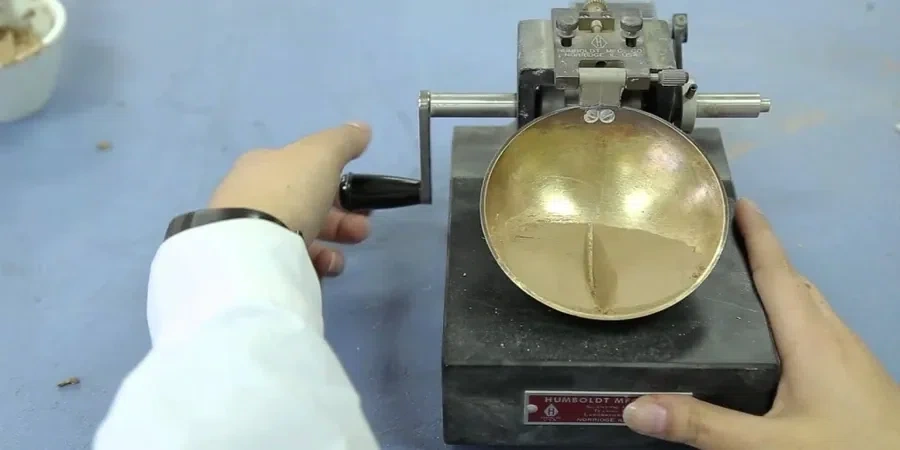
Casagrande cup method with multipoint determination. We report the flow curve and the LL value at 25 blows.
Plastic Limit Testing
Hand-rolling method at the exact crumbling point. We run duplicate determinations for precision.
Plasticity Index Calculation
Direct computation of PI and classification into silt (ML) or clay (CL, CH) per USCS.
Combined Classification Package
Pair Atterberg limits with grain-size analysis and natural moisture content for a complete geotechnical index report.
Typical parameters
Top questions
What do Atterberg limits actually tell me about my Langley site?
They quantify how your fine-grained soil behaves with water. The liquid limit shows when it flows. The plastic limit shows when it crumbles. The plasticity index tells you the shrink-swell potential. In Langley's silty clays, a high PI means the soil will expand when wet and crack when dry. This directly affects foundation depth, pavement thickness, and retaining wall design.
How much does Atterberg limits testing cost in Langley?
Standard Atterberg limits testing runs between CA$100 and CA$150 per sample, depending on whether you need just the limits or a full classification package that includes grain-size analysis. Volume pricing applies for projects with more than ten samples.
How long does the test take from sample to report?
Standard turnaround is 3 to 5 business days. The sample needs to air-dry or be oven-dried to the proper consistency before we run the Casagrande cup and plastic limit rolls. Rush processing is available if your contractor is waiting on results to finalize a subgrade acceptance.
Do I need Atterberg limits if I already have a grain-size analysis?
Yes, because grain-size only tells you the particle distribution. It does not measure how the fines fraction behaves with moisture. Two soils can have identical silt and clay percentages but completely different plasticity. Atterberg limits complete the USCS classification and give you the engineering behavior data that grain-size alone misses.