The Fraser River shaped Langley's ground long before any surveyor laid out its township grid. What looks like flat, buildable land from 200 Street is often loose alluvial sand and silt deposited by ancient flood channels. Shift your weight at the edge of a test pit near the Nicomekl and you feel it give—that same loose matrix causes differential settlement under footing loads. We see it across every industrial park expansion in Gloucester and every low-rise residential block going up in Willoughby. Vibrocompaction design in Langley has to account for this fluvial variability: sand lenses that pinch out over five metres, water tables that rise in November, and a seismic hazard that NBCC 2020 assigns PGA values upwards of 0.3g. Before we ever mobilise a vibrator, we run a CPT test grid to map the loose pockets and confirm fines content, because if you densify silty sand without checking drainage you can trap pore pressure instead of relieving it. When the grain-size distribution is favourable, the design sequence becomes straightforward: probe spacing, backfill gradation, and vibration energy calibrated to target a relative density above 70%. In Langley's compact industrial lots we often combine vibrocompaction with stone columns where the native sand is too thin to carry column loads on its own.
The difference between a successful vibrocompaction job and a marginal one in Langley is the CPT grid density: too sparse and you miss the silty lenses that choke drainage during vibration.
Method and coverage
Regional considerations
We walked onto a site just off 56 Avenue where the contractor had already poured a slab-on-grade for a warehouse extension. Cracks spiderwebbed across the floor within six months. A single CPT sounding revealed the problem: four metres of loose silty sand with an N60 below eight blows per foot, sitting on a dense till that created a perched water table. The original geotechnical report had missed the lateral variability. We designed a perimeter vibrocompaction program to densify the upper four metres without demolishing the slab—tight probe spacing at 1.5 metres, low-amplitude vibration near the footings, and real-time settlement monitoring with a total station. The floor came back to level within 8 mm. That outcome is possible only when the design accounts for Langley's two seasonal groundwater peaks: the November rains recharging the sand, and the May freshet pushing the Nicomekl over its banks and saturating the floodplain soils. Skip the drainage analysis in the vibrocompaction design and you risk building excess pore pressure instead of relieving it. For sites where fines content exceeds 15%, we incorporate a liquefaction assessment to confirm that vibrocompaction is still the right tool before we commit to the probe layout.
Standards that apply
NBCC 2020 – Seismic hazard and site classification, ASTM D6066/D6066M – Standard practice for determining normalized penetration resistance of sands for liquefaction potential, CSA A23.3 – Concrete structures and foundation requirements, ASTM D5778 – Standard test method for electronic friction cone and piezocone penetration testing (CPT), NCEER/NSF 1997 – Liquefaction resistance of soils (Youd-Idriss framework)
Complementary services
Pre-treatment CPT investigation
We design a CPT grid at 10 to 15 metre spacing to map loose sand lenses, measure tip resistance and sleeve friction, and estimate pre-treatment relative density. Each sounding resolves the contact with the underlying till or glaciomarine clay that marks the base of treatment.
Vibrocompaction probe layout and specification
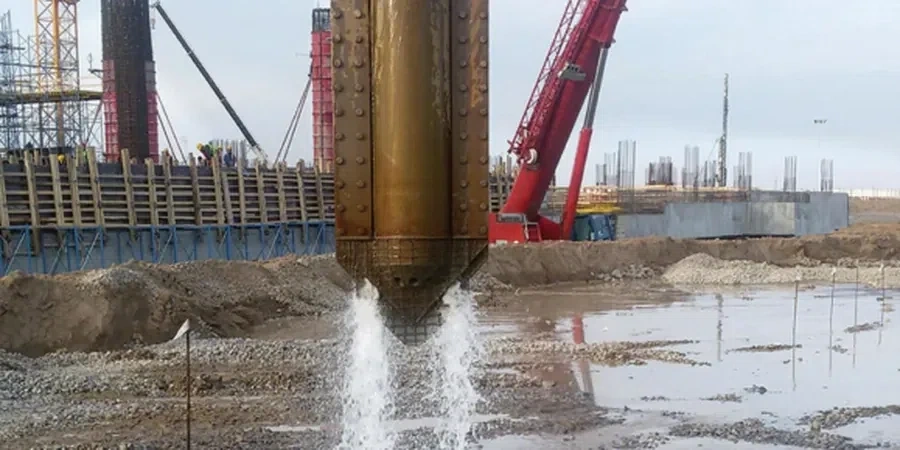
Using the CPT profiles we select vibrator type, probe spacing, backfill gradation, and lift increments. The design includes water pressure and flow rate for jetting, sequence of penetration, and real-time settlement monitoring thresholds for each probe location.
Post-treatment verification and QA/QC
Within 72 hours of compaction we run CPT soundings at centroid positions between probes to confirm the relative density target. We compare pre- and post-treatment cone resistance, compute the improvement factor, and issue a signed verification report with as-built probe logs.
Typical parameters
Top questions
How much does vibrocompaction design cost for a typical Langley site?
For most industrial and low-rise residential sites in Langley, the design cost ranges from CA$1,890 to CA$7,270 depending on the treated area, number of CPT soundings required, and complexity of the groundwater analysis. A basic package covering CPT grid layout, probe spacing design, and post-treatment verification criteria falls at the lower end; adding seasonal groundwater monitoring or finite-element settlement modelling moves toward the upper range.
What soil types in Langley respond best to vibrocompaction?
Clean to slightly silty sands with less than 12 to 15% fines content and a coefficient of uniformity below 3 respond best. Langley's Fraser River deposits and glacial outwash sands often fall within this range, but lenses with higher silt content require careful evaluation because fines reduce permeability and can trap pore pressure during vibration. We always run a grain-size analysis before finalizing the design.
How deep can vibrocompaction treat in the Fraser Valley?
With our standard 130 kW electric depth vibrator we can reach 18 metres below the working platform, which covers most loose sand deposits in Langley. Deeper treatment is possible with larger vibrators and modified probe configurations, but in practice the loose sands here typically overlie dense till or glaciomarine clay at depths between 8 and 15 metres, so 18 metres is generally sufficient.
How quickly can you verify compaction results after treatment?
We run verification CPT soundings within 72 hours of completing the vibrocompaction passes. This allows any excess pore pressure generated during vibration to dissipate, giving a reliable measurement of the improved relative density. We compare pre- and post-treatment cone resistance at the same depths and provide the improvement factor in the final report.