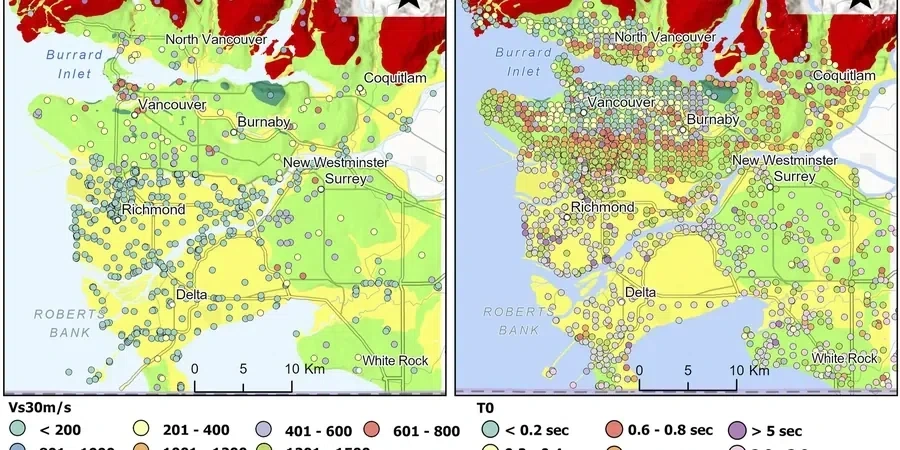
Langley sits on the edge of the Fraser River floodplain, where thick deposits of glacial till and soft silts create sharply variable seismic response. The Township now requires a site-specific seismic microzonation for many mid-rise projects under NBCC 2020, particularly east of 200 Street where the clay layer deepens. We deliver the full analysis: surface-wave testing, downhole shear velocity profiles, and 1D equivalent-linear modeling. Clients get a clear site class (C, D, or E) and design spectra ready for their structural engineer. For sites near the Nicomekl River, we often pair microzonation with liquefaction assessment because the groundwater sits within 2 meters of grade, and the fine sands in that corridor are classic Seed-Idriss candidates.
A wet-season VS30 in Langley floodplain can drop a full site class compared to a dry-season measurement, and NBCC 2020 does not let you average the two.
Method and coverage
Regional considerations
A six-storey mixed-use project on Fraser Highway was designed with a Site Class C assumption from a desktop geological map. The actual site lay over 18 meters of soft compressible silt, and the geotechnical investigation stopped at 9 meters. When the Township reviewer flagged the discrepancy, the developer had already locked structural drawings. We remobilized within a week, ran a full seismic microzonation with deep borehole shear-wave measurements, and confirmed Site Class E. The structural redesign added three months and a six-figure cost to the shear walls. The lesson: Langley's subsurface changes within a single block, and NBCC 2020 demands proof, not presumption. Getting the SPT drilling deeper on the first pass would have caught the transition to soft silt before the design phase closed.
Standards that apply
NBCC 2020 (National Building Code of Canada), CSA A23.3-19 (Design of Concrete Structures – Seismic), ASTM D4428/D4428M (Crosshole Seismic Testing)
Complementary services
Site Class Determination & VS30 Profiling
MASW and downhole testing to establish NBCC 2020 site class. Includes 1D SHAKE analysis, design spectra, and a stamped report ready for Township of Langley building permit submission.
Liquefaction Hazard & Ground Motion Integration
SPT- and CPT-based liquefaction triggering analysis per NCEER methodology, paired with site-specific PGA and M7.5-equivalent magnitude. Delivers post-liquefaction settlement estimates and lateral spreading displacement for foundation design.
Typical parameters
Top questions
What does a seismic microzonation study cost for a typical Langley lot?
Budget between CA$5,130 and CA$25,240 depending on the number of test points, depth of investigation, and whether liquefaction analysis is required. A basic VS30 determination with one MASW line and one downhole test starts near the lower end. Adding deep SPT drilling and cyclic resistance modeling moves toward the upper range.
How long does the Township of Langley take to review a microzonation report?
Typical review time is three to four weeks once the report enters the building permit queue. Reports that follow the APEGBC seismic guidelines and include clear NBCC 2020 site class justification tend to move faster. We format all deliverables to match the Township's current submission checklist.
Do you need a microzonation for a single-family home in Langley?
Under NBCC 2020 Part 4, single-family dwellings classified as low importance usually do not require site-specific microzonation. However, if your lot is on a known soft-soil corridor or near the Nicomekl floodplain, a basic VS30 screening can protect against unexpected settlement during a moderate event.
Can you combine microzonation with a regular geotechnical investigation?
Yes, and that is the most cost-effective path. We run the seismic testing during the same mobilization as your SPT drilling or CPT sounding. The borehole log, shear-wave velocity, and liquefaction analysis then appear in a single integrated report, which simplifies both the Township review and your structural engineer's workflow.