The glacial till and marine clay deposits underlying Langley Township don't always cooperate when you're cutting into a slope. We've seen it on sites near the Nicomekl River and along the steeper sections of the 200th Street corridor — what looks like stable ground can hide weak lenses or a perched water table that changes everything after the first heavy rain. A proper slope stability analysis here has to account for more than just geometry. Our team combines in-situ permeability testing to understand groundwater flow with laboratory triaxial shear strength measurements to build a model that reflects what's actually happening in the ground, not what a textbook says should happen.
A slope stability analysis is not just about whether it stands today — it's about what happens when the conditions change, and in Langley, they always do.
Method and coverage
Regional considerations
Langley's growth over the past three decades has pushed development into areas that earlier generations would have left alone — steeper hillsides, ravine edges, and land with documented landslide history along the Fraser River bluffs. The Township's own slope hazard mapping flags several zones where any new construction triggers a geotechnical review, and for good reason. A failure here doesn't just affect your lot; it can take out a road, damage downstream properties, or block a drainage course. The financial exposure goes well beyond repair costs. We work with the regulatory framework so you don't get stuck in permit limbo, delivering analyses that satisfy both the letter and the intent of the BC Building Code slope provisions.
Standards that apply
NBCC 2020 — Section 4.2.4 Slope Stability, CSA + ASTM D2850 — Unconsolidated-Undrained Triaxial Compression Test, ASTM D4767 — Consolidated-Undrained Triaxial Compression Test, ASTM D5084 — Hydraulic Conductivity by Flexible Wall Permeameter, BC Ministry of Transportation — Geotechnical Design Guidelines for Slope Stability
Complementary services
Desktop and field slope assessments
Site reconnaissance, topographic review, and preliminary stability screening. We identify obvious hazards before you commit to a full investigation.
Detailed stability analysis and reporting
Limit equilibrium modeling with coupled groundwater analysis. Complete report sealed by a professional engineer, ready for municipal submission.
Remediation and reinforcement design
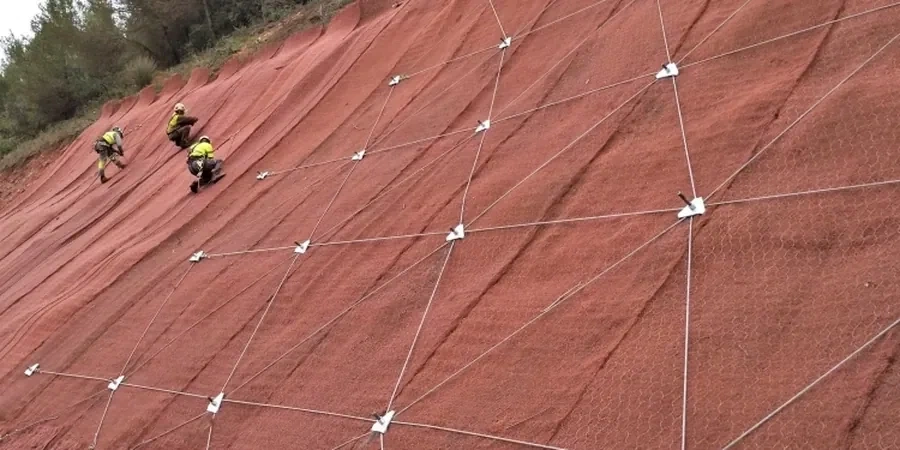
When a slope doesn't meet the required factor of safety, we design buttresses, retaining structures, drainage systems, or soil nailing to bring it into compliance.
Typical parameters
Top questions
How much does a slope stability analysis cost for a typical residential lot in Langley?
For a standard single-family building lot in Langley Township, a slope stability analysis typically ranges from CA$1,920 to CA$6,550 depending on the slope height, site access, and whether subsurface investigation is already available. Complex sites with multiple slope faces, deep failures, or the need for remediation design will fall at the higher end. We provide a fixed-fee proposal after an initial site review.
When is a slope stability analysis required by the Township of Langley?
The Township triggers a geotechnical review when you're building within a mapped slope hazard area, on slopes steeper than 15 degrees, or within setback distances from the top or toe of a slope. The exact distance depends on slope height and geology. We can help you determine if your property falls into a review zone before you submit your building permit application.
How long does the analysis take from start to finish?
A field investigation typically takes one to two days on site. Laboratory testing of soil samples runs two to three weeks depending on the type of tests needed. After we have the lab data, the analysis and report drafting takes another one to two weeks. In total, plan on four to six weeks for a complete study from initial site visit to final sealed report.
What happens if my slope doesn't meet the required factor of safety?
If the calculated factor of safety falls below the NBCC minimums, we don't just hand you a failing report. We evaluate remediation options — things like slope regrading, subsurface drainage to lower the water table, toe buttresses, or retaining structures — and present a practical solution that brings the slope into compliance while working within your budget and site constraints.