Langley’s subgrade conditions shift dramatically within a few hundred meters — from well-drained glacial till on the uplands to compressible silty clay in the low-lying areas near the Nicomekl River floodplain. That variability makes the soaked CBR test indispensable before placing structural fill or designing pavement sections. We run the laboratory CBR on remolded specimens compacted at optimum moisture content, then soak them for 96 hours to simulate worst-case saturation. The test result feeds directly into the AASHTO 1993 pavement design equation and BC Ministry of Transportation and Infrastructure (BC MoTI) standard drawings, dictating whether the section needs a thicker granular base or a cement-stabilized subgrade. Complementing the CBR with a Proctor test ensures the compaction target used in the lab matches the field specification, and pairing it with a grain-size analysis flags fines content that could trigger frost-heave susceptibility under Langley’s seasonal freeze-thaw cycles.
A soaked CBR below 2% on Langley’s silty clay means the subgrade cannot support construction traffic without a stabilization plan — it is that simple.
Method and coverage
Regional considerations
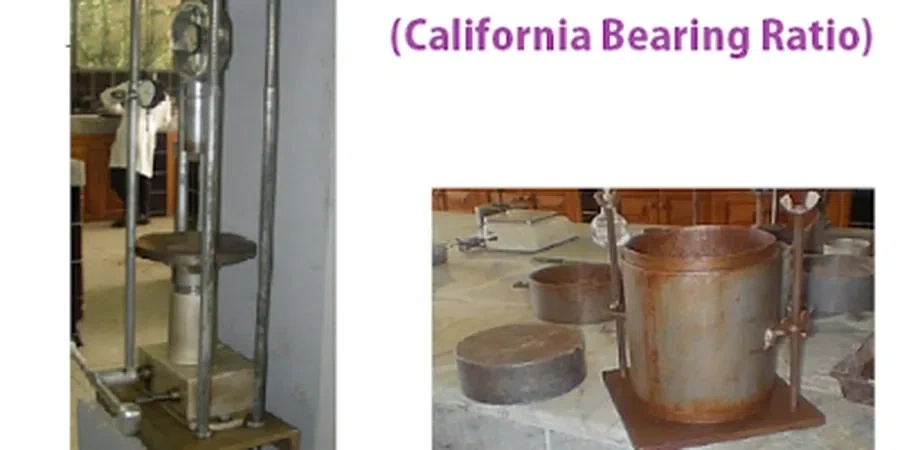
The loading frame used in our Langley laboratory applies penetration at a constant 1.27 mm per minute through a motorized screw jack, while a calibrated load cell captures the reaction force at 0.025 mm displacement increments. Skipping the 96-hour soak is the most common mistake we see on contractor-submitted reports: unsoaked CBR values on Langley’s clay-rich tills can read 12% or higher, then collapse to below 3% after saturation, leading to premature rutting and edge cracking within the first two winters. The test also records swell percentage during soaking — on some Fort Langley clays we have measured swell exceeding 4%, which signals a need for lime treatment or a capillary break layer beneath the pavement structure. A single CBR test costs less than a square metre of asphalt mill-and-replace, yet the data drives the entire pavement thickness design and prevents six-figure maintenance liabilities.
Standards that apply
ASTM D1883-21 Standard Test Method for California Bearing Ratio (CBR) of Laboratory-Compacted Soils, AASHTO T 193-22 Standard Method of Test for The California Bearing Ratio, BC MoTI Standard Specifications for Highway Construction (Section 202 – Granular Base and Sub-Base), ASTM D698-12(2021) Standard Test Methods for Laboratory Compaction Characteristics of Soil Using Standard Effort
Complementary services
Modified Proctor Compaction (ASTM D1557)
Determines the maximum dry density and optimum moisture content at modified compactive effort — the compaction reference curve from which CBR specimens are molded. Essential for BC MoTI specification compliance on arterial and collector roads.
Grain-Size Distribution with Hydrometer (ASTM D7928)
Quantifies the silt and clay fraction passing the 75 µm sieve. Combined with the CBR, this test identifies frost-susceptible soils (more than 10% passing 0.02 mm) that require a thicker granular sub-base in Langley’s freeze-thaw climate.
Typical parameters
Top questions
How much does a laboratory CBR test cost in Langley?
A single-point soaked CBR test (three specimens at the specified compactive effort) typically runs between CA$180 and CA$260, depending on whether the Proctor compaction curve is already available or must be developed first. Volume pricing applies for projects requiring five or more CBR points.
How long does it take to get CBR test results?
Standard turnaround is 3 to 5 working days from sample receipt. The 96-hour mandatory soaking period sets the minimum timeline; we expedite compaction and penetration phases to release the report the morning after the soak concludes. Same-day unsoaked CBR is available for quality-control checks on granular borrow materials.
What is the difference between laboratory CBR and field CBR?
Laboratory CBR (ASTM D1883) tests a remolded specimen compacted at controlled moisture and density, then soaked to simulate long-term saturation. Field CBR (ASTM D4429) measures in-place bearing capacity directly on the compacted subgrade. The lab value is used for pavement thickness design; the field value is used for construction acceptance. On Langley projects, BC MoTI typically specifies the laboratory soaked CBR for design and requires field density plus DCP correlations for QA.