The soil profile changes sharply between Willoughby and Aldergrove. In Willoughby you hit dense till within a few meters. Cross over to the Gloucester flats and the clay runs deep. That contrast in bearing capacity means a standard shallow footing might work in one block and fail in the next. Stone column design bridges that gap. When we run a CPT on a Langley site with 6 m of soft silt, we look at undrained shear strength below 30 kPa. That is where stone columns become the rational choice. The load-transfer mechanism relies on radial confinement from the native soil, so the column spacing, diameter, and aggregate gradation all depend on the in-situ stiffness. We typically pair this investigation with CPT testing to capture a continuous strength profile, and triaxial testing on undisturbed samples to confirm the friction angle of the matrix soil.
A well-designed stone column transfers 80 percent of the foundation load to the aggregate, leaving the native soil to provide lateral confinement only.
Method and coverage
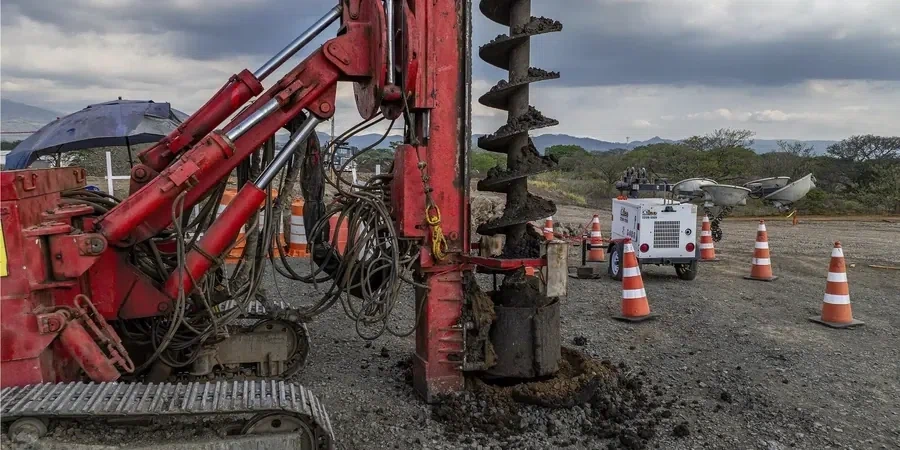
Regional considerations
A 3-storey mixed-use building on Fraser Highway, near the old CN rail corridor, sat on 7 m of soft organic silt. The geotechnical report recommended a rigid inclusion system, but the contractor pushed for a stone-column alternative to meet a tight budget. Without proper stone column design, the risk was differential settlement exceeding 25 mm between column-supported and untreated zones. We ran two full-scale load tests on isolated columns to calibrate the modulus. The key failure mode is bulging in the upper 2 to 3 diameters, where confining stress is lowest. By placing a stiffer soil-cement cap over each column, we restricted radial strain and kept total settlement under 15 mm. Neglecting the cap detail would have compromised the floor slab within the first year.
Standards that apply
NBCC 2020, ASTM D448 Standard Classification for Sizes of Aggregate for Road and Bridge Construction, CSA A23.3 Design of Concrete Structures (for column caps and load-transfer platforms)
Complementary services
Vibro-replacement stone columns
Wet and dry top-feed methods for soft silts and clays. We design the grid spacing and aggregate specification to meet the settlement criteria in the NBCC serviceability limit state.
Load test and verification
Full-scale static load tests on single columns and groups, instrumented with tell-tales to measure load transfer. Results are used to validate the improvement factor and confirm allowable bearing pressure.
Typical parameters
Top questions
What does stone column design cost for a typical Langley site?
For a lot in Langley Township, stone column design fees typically range from CA$1,970 to CA$8,070, depending on the treated area, number of CPT soundings required, and whether full-scale load testing is included in the scope.
How deep can stone columns be installed in Langley's glaciolacustrine deposits?
We routinely install columns to depths of 6 to 14 m in the Sumas clay and Fort Langley silt units. Depth is governed by the presence of a competent bearing stratum, usually the Vashon till. CPT refusal or a sharp increase in tip resistance marks the termination depth.
What aggregate specification is required for stone columns?
Per ASTM D448, we specify a clean, hard, angular crushed stone with a nominal size of 20 to 50 mm. The fines content passing the No. 200 sieve must be below 5 percent to maintain high permeability. Local basalt from the Coquitlam quarries commonly meets these requirements.