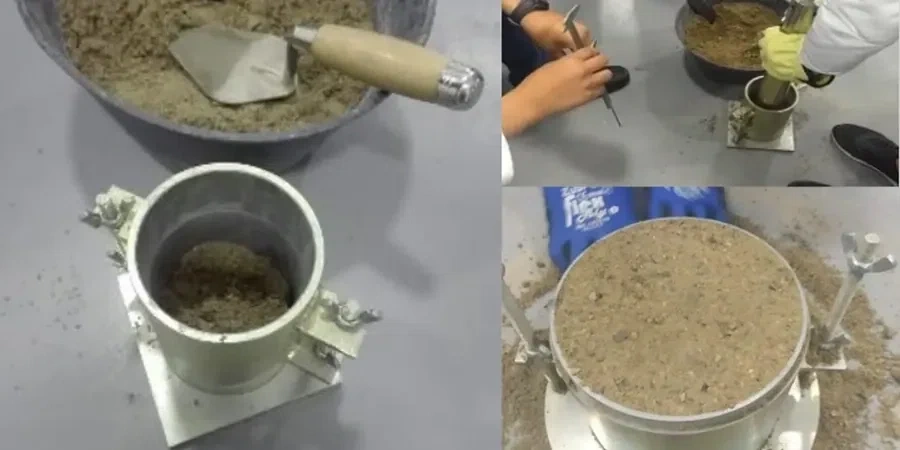
Standard and Modified Proctor tests in Langley follow ASTM D698 and D1557 to establish the moisture-density relationship of compacted fill. The Township of Langley sits on a complex mix of glacial till, glaciomarine silts, and alluvial deposits from the Fraser and Nicomekl rivers, where uncontrolled compaction can lead to settlement differentials exceeding 25 mm in the first wet season. Our lab runs both standard effort (12,400 ft-lbf/ft³) and modified effort (56,000 ft-lbf/ft³) curves depending on the structural loading specified in the geotechnical report. The results feed directly into field density acceptance criteria, typically 95% or 98% of the lab maximum dry density, as required by the BC Building Code and municipal engineering standards. For deeper fills on commercial pads in the Gloucester Industrial Park, we often pair Proctor curves with sand cone density field checks to verify lift-by-lift compliance before paving or slab-on-grade placement.
A single percentage point deviation from optimum moisture in Langley's silty fills can cut relative compaction by 3 to 5 points in the field.
Method and coverage
Regional considerations
Langley recorded a 4.8-magnitude earthquake in 2015 with an epicenter near Aldergrove, a reminder that the Cascadia Subduction Zone governs the seismic hazard across the Lower Mainland. Poorly compacted structural fill amplifies the risk of liquefaction-induced settlement in the loose alluvial silts of the Fraser Lowlands, and post-shaking differential movement can render slab-on-grade foundations unserviceable. A Modified Proctor curve provides the target density for engineered fill placed beneath footings, floor slabs, and retaining wall backfill, directly tying compaction quality to seismic resilience. Without a lab-derived compaction specification, the field inspector has no verifiable benchmark to accept or reject a lift, and the structural designer loses the link between geotechnical recommendation and as-built condition. The BC Building Code 2018 references CSA A23.3 for concrete structures and implicitly relies on properly compacted subgrade as a deformation-control layer; gaps in compaction data create liability exposure for the owner and the contractor alike.
Standards that apply
ASTM D698-12 (2021) - Standard Proctor, ASTM D1557-12 (2021) - Modified Proctor, ASTM D4718-15 - Oversize Correction, BC Building Code 2018, CSA A23.3-14 - Concrete Structures
Complementary services
Standard Proctor (ASTM D698)
Recommended for residential subdivisions, landscape berms, and utility trench backfill where compaction effort matches typical light to medium equipment. We run the full five-point curve on a representative bulk sample and deliver the moisture-density plot with the zero-air-voids curve within two business days.
Modified Proctor (ASTM D1557)
Specified for commercial and industrial building pads, highway embankments, and structural fill under heavy footings. The higher compactive effort simulates modern vibratory rollers and padfoot compactors operating on 200-300 mm lifts, producing MDD values 5 to 12% above the Standard curve.
Typical parameters
Top questions
How much does a Proctor test cost for a Langley project?
A Standard Proctor (ASTM D698) curve runs CA$140 to CA$200 per sample; a Modified Proctor (ASTM D1557) runs CA$230 to CA$330, depending on whether oversize correction is needed. Volume pricing applies for multi-sample projects, and we include the moisture-density plot with the zero-air-voids curve in every report.
Which Proctor standard does the Township of Langley require?
Most residential and light commercial projects in Langley reference 95% of Standard Proctor (ASTM D698) for general fill and 98% for structural fill under slabs. Heavily loaded industrial pads and road embankments typically require Modified Proctor (ASTM D1557) per the geotechnical engineer's specification, especially on sites with vibratory roller compaction spreads.
How do you handle gravel and oversize particles in Langley's glacial till?
When the sample contains more than 30% retained on the No. 4 sieve, we switch to the 6-inch mold and apply the ASTM D4718 correction to remove the bias that oversize particles introduce into the density calculation. This is common in upland Langley where till contains cobbles and gravel lenses, and skipping the correction can overestimate field compaction by 2 to 4 percentage points.
How long does it take to get Proctor results for a fast-track project?
Standard turnaround is two business days from sample delivery. We can compress to same-day results for rush projects when the sample arrives before 9:00 AM, provided the soil is oven-dried overnight at our Langley lab. The curve, data table, and zero-air-voids line are delivered as a certified PDF with our ISO 17025 stamp.