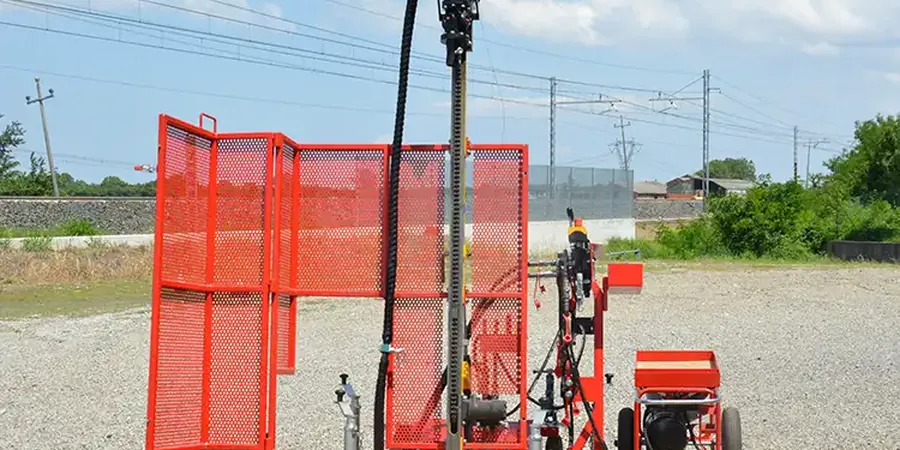
A CME-75 track rig moves into position on a lot near the Nicomekl River, its cathead hammer ready to drop. This is the core of an SPT investigation in Langley—direct measurement of soil resistance every 1.5 meters as the split-spoon sampler advances through the subsurface. The township sits at roughly 15 meters elevation, but what lies beneath varies dramatically: dense Vashon glacial till on the uplands and thick compressible silts in the floodplain. The standard penetration test remains the most widely specified method for quantifying these contrasts. For sites where continuous profiling is required, the team often pairs SPT data with CPT soundings to capture pore pressure response in the soft clays. In accessible areas, preliminary test pits help identify fill thickness before the drill rig arrives.
N-values above 30 in Langley's Vashon till typically indicate a dense bearing stratum suitable for spread footings, eliminating the need for deep foundations.
Method and coverage
Regional considerations
In Langley, the transition zone between the upland till and the low-lying Fraser River deposits creates a specific risk: differential settlement where a building footprint straddles two soil types. SPT refusal in till on one side and N-values of 4 to 8 in soft silt on the other demand careful foundation detailing. The team has encountered peat lenses in the Langley Prairie area—undetectable without penetration testing—that compress significantly under load. A liquefaction assessment becomes essential for sites within 500 meters of the Fraser River or Nicomekl floodplain, where saturated granular soils can lose strength during a design earthquake. Skipping the SPT investigation in these areas leads to overdesign or, worse, foundation underperformance that no amount of structural reinforcement can fix.
Standards that apply
ASTM D1586-18 Standard Test Method for Standard Penetration Test (SPT) and Split-Barrel Sampling of Soils, NBCC 2020 Part 4 Structural Design – Section 4.2 Foundation Design, CSA A23.3 Design of Concrete Structures – Foundation embedment and bearing, ASTM D2488 Description and Identification of Soils (Visual-Manual Procedure)
Complementary services
Residential SPT Drilling
One or two boreholes to 10–15 meters depth on single-family lots. Provides N-values, soil classification, and water table depth for building permit submissions in the Township of Langley.
Commercial SPT Program
Multi-borehole investigation with sampling at 1.5-meter intervals. Includes energy-corrected N60 values and foundation recommendations for strip footings, pad footings, or mat foundations.
SPT with Liquefaction Screening
For sites in the Fraser River floodplain. Combines SPT N-values with grain size data to evaluate liquefaction potential using NCEER/Youd-Idriss methodology, required for seismic design per NBCC.
Typical parameters
Top questions
How much does an SPT investigation cost for a typical Langley residential lot?
For a standard single-family lot in Langley, an SPT investigation with one borehole to 10–15 meters depth ranges from CA$640 to CA$1,160. The final cost depends on access conditions, depth required, and whether supplementary lab testing like grain size or Atterberg limits is needed.
How deep do SPT boreholes go in Langley?
Depth depends on the foundation type and soil conditions. For residential projects, boreholes typically extend 10 to 15 meters or until refusal in dense till. Commercial investigations on the Fraser floodplain may reach 25 meters to assess deep compressible layers and liquefaction potential.
What is the turnaround time for an SPT report?
Field drilling takes one to two days depending on the number of boreholes. The geotechnical report with N-values, soil profiles, and foundation recommendations is delivered within five to seven business days after the field work is complete.