Langley sits roughly 15 meters above sea level on the floodplain of the Fraser River, where a thick sequence of Holocene alluvium and peat lenses defines the subsurface—conditions that routinely push structural engineers toward raft/mat foundation solutions. The 1946 Vancouver Island earthquake, felt strongly across the Lower Mainland, reminded the region that uniform settlement control and seismic load distribution are not abstract goals but daily design constraints. Raft/mat foundation design in this township requires more than a uniform pressure assumption; it demands soil-structure interaction modeling calibrated against real CPT test data to capture the abrupt transitions from medium-dense sand to compressible silty clay that characterize the Langley basin. Our approach integrates stratigraphic profiling, consolidation parameters, and bearing capacity verification under NBCC 2020 load combinations, producing a foundation system that limits differential movement even when the bearing stratum dips unpredictably.
A mat foundation in Langley’s floodplain is not a rigid plate on springs — it is a flexural element negotiating a mosaic of compressible lenses.
Method and coverage
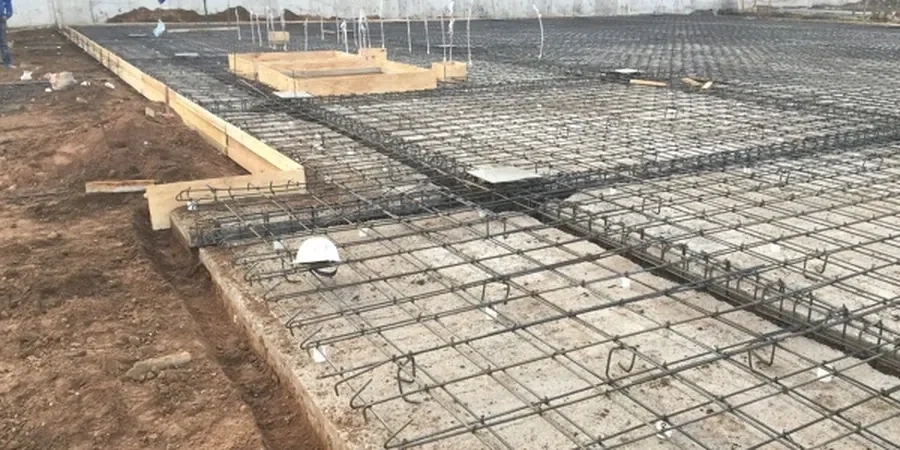
Regional considerations
The Fraser Lowland stratigraphy beneath Langley packs a particularly troublesome combination: a desiccated crust of stiff clay that grades into normally consolidated, highly compressible silts at depths of just 4 to 7 meters. A raft foundation that appears to bear on the crust with a healthy factor of safety can still experience long-term differential settlement exceeding 30 mm if the underlying soft layer compresses unevenly under the stress bulb. The phenomenon is exacerbated where municipal drainage alters the water table seasonally, introducing shrink-swell cycles in the upper meter of soil that relax the soil-structure contact. Seismic demands add a second layer of concern: the NBCC places much of Langley in Site Class D or E, and a mat foundation must be detailed to resist both inertial forces from the superstructure and kinematic bending induced by vertically propagating shear waves. Ignoring the kinematic component — particularly where the slab spans across a sharp impedance contrast — can concentrate flexural cracking at column perimeters, a failure mode that post-earthquake reconnaissance has documented in soft-soil basins worldwide.
Standards that apply
NBCC 2020 — Structural loads, seismic hazard and foundation design provisions, CSA A23.3:2019 — Design of concrete structures (reinforcement detailing, durability), ASTM D1194/D1194M — Standard test method for bearing capacity of soil for static load on spread footings/rafts, Eurocode 7 (EN 1997-1:2004) — Geotechnical design (referenced for serviceability limit state methodology), NCEER/NSF — Liquefaction resistance assessment (Youd & Idriss 2001, invoked in seismic settlement analysis)
Complementary services
Geotechnical Interpretative Report for Raft Design
Compilation of In-Situ — CPT, SPT, and shear wave velocity profiles — to build a layered soil model with drained and undrained parameters for immediate settlement, primary consolidation, and secondary compression calculations.
Subgrade Modulus and Spring Constant Calibration
Point-specific Winkler spring stiffnesses derived from field tests and consolidation theory, formatted as input files for structural finite element software (SAFE, RAM Concept, or equivalent).
Raft Reinforcement Detailing & Punching Shear Verification
Flexural and shear design per CSA A23.3, including punching shear checks at column connections, edge thickening details, and construction joint layout coordinated with the geotechnical settlement profile.
Improvement Design Beneath the Mat
Design of stone columns or rigid inclusions to reduce total and differential settlement, with verification testing (plate load tests, post-treatment CPT) executed before raft concrete placement.
Typical parameters
Top questions
When does a raft/mat foundation become necessary instead of isolated footings in Langley?
A raft typically becomes the recommended solution when the combined footing area exceeds roughly 50% of the building footprint, or when differential settlement between columns is predicted to surpass 15 mm based on the geotechnical model. In Langley’s floodplain areas, the presence of discontinuous peat lenses and soft silts at depths less than 8 m often triggers the raft decision early in design, because the mat bridges these irregularities and reduces eccentric loading on individual footings.
What is the approximate fee range for a raft foundation design package in Langley?
The complete design package — including the geotechnical interpretative report, subgrade reaction calibration, and structural detailing of the mat — generally falls between CA$1,330 and CA$6,100 depending on building area, number of column lines, and whether Improvement design is required. A single-family residence on a simple rectangular plan will sit at the lower end, while a multi-story mixed-use building with irregular column grids and seismic class D/E conditions moves toward the upper bound.
How is the seismic demand on a mat foundation addressed under the NBCC?
The NBCC 2020 requires that mat foundations be designed for both inertial forces transmitted from the superstructure and kinematic soil-structure interaction effects. We calculate the design spectral accelerations for the specific site class — often D or E in Langley — and apply them in a response spectrum analysis. The mat is checked for in-plane diaphragm forces, overturning moment transfer, and the flexural demands that arise when the foundation slab is subjected to curvature from vertically propagating shear waves.
Can you design the raft and also arrange the soil investigation in Langley?
Yes, the typical workflow begins with a field investigation — CPT soundings, mud rotary boreholes with SPT sampling, and occasionally MASW lines for shear wave velocity — that we coordinate with a local drilling contractor. The data feeds directly into the geotechnical model used to calibrate the subgrade reaction parameters, eliminating the information loss that often occurs when the investigation and design are handled by separate entities.